Education
FG Launches Nationwide School Internet Connectivity Initiative

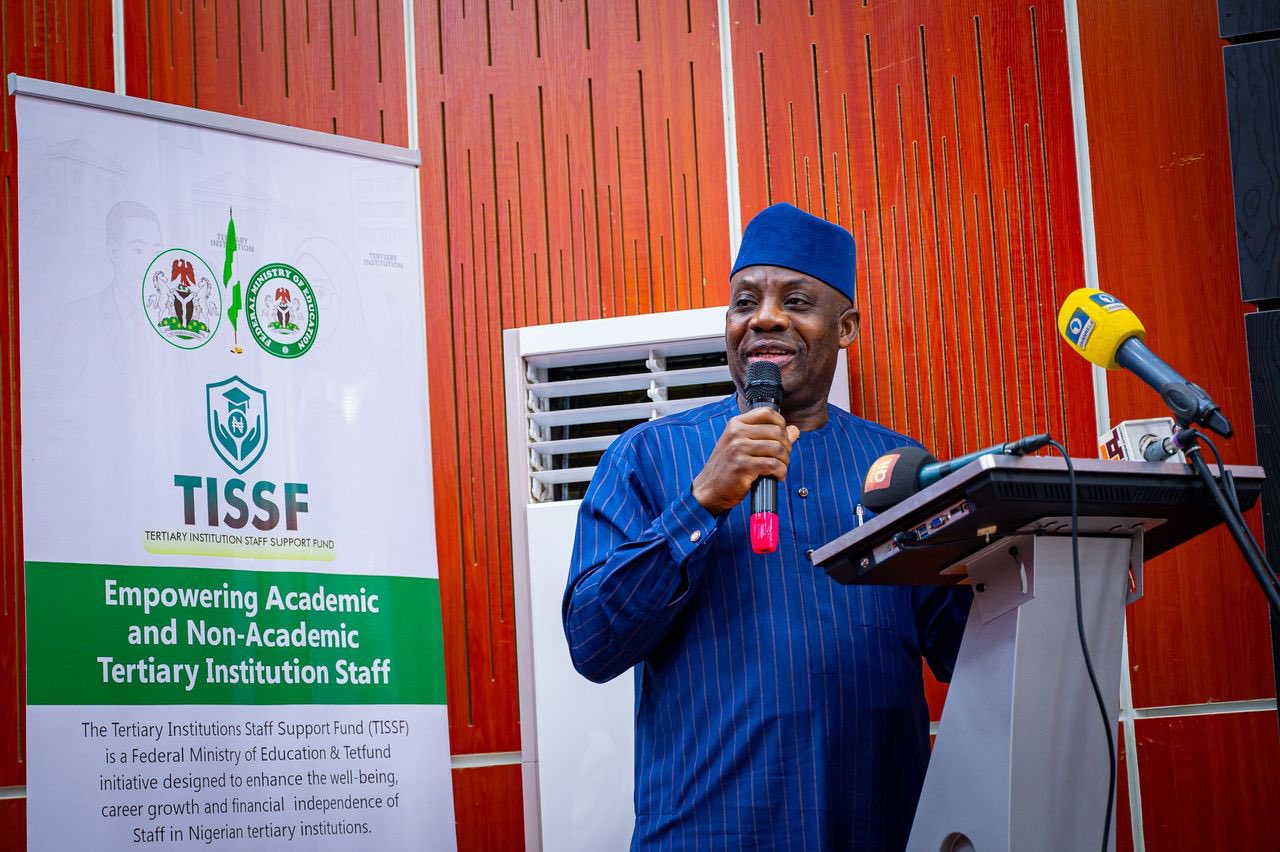
The Federal Government launches a nationwide initiative to connect Nigerian schools to reliable internet, enhancing digital learning and AI integration

The Federal Government has launched a new programme to provide reliable internet access to schools across Nigeria, aiming to expand digital learning and integrate modern technologies, including artificial intelligence, into the country’s education system.
Also read: Tinubu Approves Hiring of 50 Doctors, 100 Nurses for Nigerian Correctional Centres
The initiative follows a directive by President Bola Tinubu to accelerate national digital infrastructure expansion and ensure key sectors, especially education, benefit from broadband and telecommunications investments.
The Minister of Education, Maruf Alausa, and the Minister of Communications, Innovation and Digital Economy, Bosun Tijani, met in Abuja with key stakeholders to coordinate the nationwide school connectivity programme.
The plan covers all levels of education, from primary and secondary schools to universities, polytechnics, and colleges of education.
Alausa noted that the initiative builds on prior efforts through the Nigerian Research and Education Network (NgREN), which supported broadband for tertiary institutions under a World Bank-funded project.
He explained that the programme slowed after initial funding ended, making revival and expansion necessary.
“Connectivity is not limited to broadband fibre alone. It also involves telecommunications towers, satellite systems, and other infrastructure required to provide reliable internet access across the country,” Alausa said.
Currently, the government is deploying around 90,000 kilometres of fibre optic broadband, installing about 3,700 telecommunications towers, and expanding satellite capacity, with schools strategically included in the network.
Two technical working groups have been created: one to improve connectivity for tertiary institutions and another to focus on foundational and secondary schools.
The NgREN governing council will also include representatives for all levels of education to strengthen coordination.
Improved internet access will allow teachers and students to use digital learning platforms, global academic resources, and emerging technologies.
Alausa said the programme will support reforms such as transitioning major national exams, including WAEC and NECO, to Computer-Based Testing.
Tijani highlighted that although Nigeria has eight international subsea internet cables—the highest in Africa—the challenge is distributing capacity inland.
The fibre expansion and rural telecom towers are designed to ensure schools benefit directly.
Also read: Tinubu Approves Hiring of 50 Doctors, 100 Nurses for Nigerian Correctional Centres
Both ministers reaffirmed the government’s commitment to collaboration between education and communications sectors, aiming to equip students with digital skills and improve access to quality education nationwide.


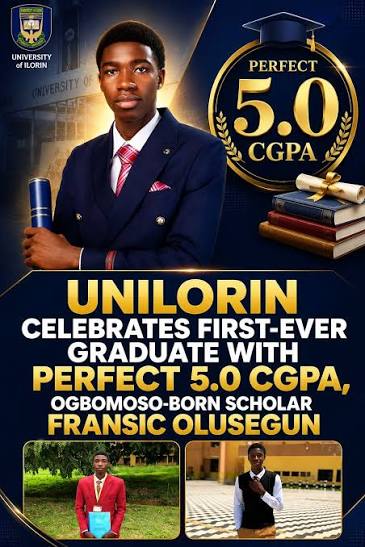
Francis Olusegun graduates as UNILORIN’s best student with a perfect 5.00 CGPA, crediting consistency, self-belief and support from others
University of Ilorin Mathematics graduate Francis Olusegun has emerged as the institution’s best graduating student for the 2025/2026 academic session, earning a perfect 5.00 Cumulative Grade Point Average (CGPA).
Also read: Deadly Nigeria Floods Kill 245, Displace 214,997
In an interview published by the Union of Campus Journalists, University of Ilorin, Olusegun attributed his achievement to self-belief, consistency and adaptability.
He said his first-year results convinced him that graduating with a perfect score was possible.
“I began to imagine graduating with a 5.00 CGPA after seeing my 100-level results. That was when the thought came to me that we could actually break the record,” he said.
Olusegun said becoming the overall best graduating student had been a personal ambition long before he set his sights on a perfect CGPA.
“I had set that goal for myself and believed that if I worked hard, I could achieve it,” he added.
Olusegun said he remained flexible with his study routine rather than follow a rigid timetable.
He revised lessons on the day they were taught, researched difficult concepts and used available tools to improve his understanding.
“Maintaining a perfect CGPA is not easy, but the first thing is that I had already won in my mind,” he said.
He also monitored his test scores closely because continuous assessment contributes to final grades.
He aimed to score above 70 per cent, giving himself a margin ahead of examinations.
His interest in Mathematics, which began in primary school, helped sustain his commitment to the subject.
“I have always enjoyed solving mathematical problems,” he said. “There is a connection between me and Mathematics, and that made it easy for me to choose it.”
The achievement comes as UNILORIN holds its 41st convocation ceremony for the 2025/2026 academic session.
Vice-Chancellor Professor Wahab Egbewole, SAN, said 16,152 graduands would receive degrees and other qualifications, including 365 students who earned first-class honours.
The ceremony was scheduled for October 21 to 23.
Olusegun acknowledged that social media sometimes distracted him, prompting him to step away from it when he needed to concentrate.
He said he also limited activities that did not align with his long-term ambitions.
One of his most difficult experiences came in his first year, when his phone became faulty and could not be repaired before his first-semester examinations.
A friend lent him another phone, allowing him to continue reading and practising.
Financial difficulties also affected his university experience.
Olusegun said he asked for help when he could not afford necessities, including food, rather than allow his circumstances to prevent him from pursuing his goals.
He said his parents were not educated and did not constantly push him academically, so much of his motivation came from within.
“My parents are not educated, so I cannot say that somebody was constantly pushing me academically. I pushed myself because I knew what I wanted to achieve,” he said.
He credited his parents, church members, friends and former students of his department with providing financial assistance, encouragement and academic guidance throughout his studies.
Olusegun described his perfect CGPA as a personal milestone and a starting point for further academic work.
He said he had consistently been the best graduating student from primary school through university and was the first person in his immediate family to earn a first-class degree.
He is considering pursuing a master’s degree or proceeding directly to a PhD, with research as his main priority.
“My next step is to further my education, either by pursuing a master’s degree or going directly for a PhD. I am interested in research, so that is the direction I want to explore,” he said.
His interests include mathematical biology and the use of mathematical models to understand and forecast infectious diseases.
He hopes such models can help public health agencies analyse disease patterns and allocate resources more effectively.
Also read: Deadly Nigeria Floods Kill 245, Displace 214,997
Olusegun also wants to explore how Mathematics and artificial intelligence can be combined to address public health and epidemiological challenges.
Nigerian universities global rankings could improve from 2027, Peter Okebukola says, citing research citations, competition and new assessment criteria
Nigerian universities could achieve record-breaking performances in global rankings from 2027, according to the Chairman of the Nigerian Tertiary Education and Research Analysis Committee, Emeritus Professor Peter Okebukola, who cited increased institutional competition, growing research citations and a new national ranking framework.
Also read: Tinubu: Strong Corporate Governance Must Go Beyond Compliance to Secure Institutional Future
Okebukola made the projection at a meeting of NiTERAC and directors of academic planning on Wednesday, October 21, 2026, according to a statement issued on Thursday.
He attributed the anticipated gains partly to the Federal Government’s efforts to strengthen how tertiary institutions are assessed, including a mandatory national ranking exercise introduced by the Minister of Education, Dr Tunji Alausa, on September 1, 2026.
According to Okebukola, the exercise is encouraging federal, state and private universities to publicise their achievements in teaching, research and community service.
He said the initiative had intensified competition among institutions, including those that had previously done little to showcase their performance.
“This mandatory directory has caused mass mobilisation of tertiary institutions in the country to gear up for the 2026 national ranking exercise,” he said.
The NiTERAC chairman also pointed to the growing participation of Nigerian academics on Google Scholar and other citation-tracking platforms as a potential driver of improved international visibility.
He said increased participation had expanded the country’s available citation data, which could contribute to stronger performances in international university rankings from 2027.
Research output and citations feature directly or indirectly in several global ranking systems, although the extent to which they affect an institution’s position varies by ranking provider and methodology.
Okebukola identified the design of the 22 indicators for the 2026 national rankings as another important factor.
He said the indicators drew on four leading international ranking systems, exposing Nigerian institutions to performance measures used globally.
He added that the national ranking exercise had reached the 12th stage of a 17-step process, while assessments of polytechnics and colleges of education were also progressing.
The committee expects to complete the rankings for all categories by December 15, 2026. Okebukola said the results would be published after the Minister of Education approves NiTERAC’s recommendations.
Beyond the 2026 exercise, the committee plans to introduce thematic rankings from 2027, with a stronger emphasis on how tertiary institutions contribute to Nigeria’s development priorities.
The proposed approach would assess not only conventional academic performance but also the practical application of knowledge, graduate capabilities and innovations that address real-world challenges.
Okebukola said the indicators could include innovations developed within the preceding two years, such as patents secured, new products created and processes introduced to tackle national development problems.
He linked the proposal to calls for graduates who can apply their knowledge competently and ethically to create value for society.
He cited United Nigeria Airlines Chairman, Professor Obiora Okonkwo, who made a similar argument during the 14th convocation lecture of Afe Babalola University in Ado-Ekiti.
According to Okebukola, the proposed thematic rankings could also offer a model for other African countries pursuing the African Union’s Agenda 2063, the continent’s long-term development framework.
The initiative comes amid continuing pressure on Nigerian universities to improve research productivity, international visibility, graduate employability and their contribution to economic and social development.
However, the projected improvement in global rankings remains an expectation rather than a confirmed outcome.
Also read: Tinubu: Strong Corporate Governance Must Go Beyond Compliance to Secure Institutional Future
Actual performance will depend on universities’ results and the methodologies applied by international ranking organisations.

-
Politics3 years ago
13 Ondo Assembly Members Disown Endorsement of Aiyedatiwa
-
Politics3 years ago
APC Group, Ondo Govt, Quarrel Over Money for Endorsement
-

 Trending News5 years ago
Stop unsavoury, inciting statements – DSS warns
-

 Others5 years ago
Adron Homes Celebrates 10 Years Of Housing Excellence
-

 Humanity5 years ago
President Buhari Commiserates With Ambassador Maureen Tamuno Over The Loss Of Her Father
-

 Others7 years ago
EX- CUSTOMS BOSS, IBRAHIM MERA’S DWINDLING FAME
-

 Business3 years ago
Bigi Carbonated Soft Drinks Treats 40 Consumers to an Epic Easter Movie Hangout
-

 Business2 years ago
Wema Bank Shines at Global SME Finance Forum Conference Awards 2024 …Awarded: • SME Financier of the Year (Africa) • Platinum Award for Best Financier for Women Entrepreneurs (Africa)