
Opinion
Yusuf Tuggar, resilient diplomat amid foreign backed false persecution


Yusuf Tuggar, Nigeria’s Minister of Foreign Affairs, has pushed back firmly against the growing tide of misinformation portraying the country as a hostile environment for Christians, warning that such narratives distort a far more complex national tragedy and threaten international cooperation.

In recent months, global commentary has been dominated by claims that Christians in Nigeria face state-backed persecution.
These allegations, amplified by lobby groups and foreign lawmakers, have gained momentum with the proposed “Nigeria Religious Freedom Accountability Act of 2025” introduced by United States Senator Ted Cruz.
The Bill, which seeks punitive measures against Abuja, paints Africa’s largest democracy as a country complicit in religious oppression.
Tuggar’s response, both in tone and substance, challenges that caricature.
He insists that Nigeria’s religious crisis is not a tale of government persecution but a humanitarian catastrophe driven by terrorism, banditry, and the collapse of rural economies.
“The reality is more complex than Western headlines admit,” he said in a recent statement.
“Terrorist groups target Christians and Muslims alike. Violence in Nigeria is not a war of religion but a war on humanity.”
His words carry weight because the numbers are devastating. According to the International Society for Civil Liberties and Rule of Law (Intersociety), thousands of Christians were killed and abducted across Nigeria between January and July 2025.
Yet these grim figures, often cited abroad as evidence of targeted Christian persecution, tell only part of the story. Thousands of Muslims have been slaughtered in similar attacks, their deaths rarely making Western headlines.
The U.S. Commission on International Religious Freedom itself acknowledges that Boko Haram and the Islamic State in West Africa Province (ISWAP) routinely murder Muslim clerics who reject extremist doctrine.
In Zamfara, Katsina, and Niger States, Muslim farmers are raided and kidnapped by the same gunmen who attack Christian villages in Benue and Plateau. The violence spares no faith, and the victims share the same grief.
By any credible measure, this is a humanitarian disaster.
In the past four years, nearly 56,000 Nigerians have been killed in violent conflicts. Millions more have been displaced. Communities have been erased from maps. Churches and mosques have been burnt, schools closed, and children orphaned on both sides of the faith divide.
Yet abroad, Nigeria’s agony is repeatedly reduced to a one-sided script: Christians are under siege, Muslims are aggressors, and the state is indifferent.
For Tuggar, this reductionism is not only lazy but dangerous.
It feeds polarisation, emboldens extremists, and risks derailing the quiet diplomatic work being done to stabilise communities.
“Nigeria’s tragedy is being weaponised for foreign politics,” he said. “We cannot afford selective empathy.”
The Foreign Minister’s frustration is understandable.
He has spent the past year re-engineering Nigeria’s global engagement around what he calls economic diplomacy. His agenda seeks to rebuild trust, attract trade, and reposition Nigeria as a cooperative but assertive player on the world stage.
Since taking office, Tuggar has represented the country at high-level forums from Addis Ababa to Abu Dhabi, where he has argued for fairer trade rules, more responsible media framing, and respect for African sovereignty.
At the Reuters NEXT Gulf Summit in October, he warned that “Africa must stop being the raw material of global pity” and instead become the architect of its own recovery.
That line, equal parts defiance and dignity, summed up his foreign policy philosophy. It is not anti-Western but anti-condescension. Tuggar’s Nigeria seeks partners, not patrons.
Behind the scenes, he has quietly reopened channels with Washington and Brussels, engaging on migration, digital trade, and counterterrorism.
His approach is diplomatic rather than dramatic. But in an age where foreign advocacy thrives on outrage, quiet effectiveness can be mistaken for invisibility.
Critics at home have occasionally described him as too restrained, too understated, perhaps even absent from the public glare. Yet the evidence suggests otherwise.
Policy continuity has returned to the Ministry of Foreign Affairs after years of drift. Nigeria’s envoys are better coordinated, its missions more engaged, and its foreign statements less reactive.
Tuggar’s refusal to perform outrage for the cameras is not weakness but strategy.
“When foreign actors make false claims, the right response is evidence, not emotion,” said a senior diplomat familiar with his thinking.
“He believes Nigeria must correct lies with facts, not fury.”
Facts are on his side.
Nigeria’s Constitution explicitly prohibits any state religion under Section 10, while Section 38 guarantees freedom of thought, conscience, and religion.
Section 42 forbids discrimination based on faith. These provisions are not ornamental; they are tested daily in courts and public life.
Where Sharia law operates in parts of the north, it applies only to Muslims and within constitutional limits. There is no federal offence called blasphemy.
Churches and mosques operate freely across the federation. Christian organisations own schools, hospitals, and media houses. The Federal Executive Council includes both Christians and Muslims.
Nigeria’s religious diversity, for all its tensions, remains one of the most open in Africa. But this reality rarely fits Western scripts that crave villains and victims.
What complicates the narrative further is that the perpetrators of Nigeria’s bloodshed are not representatives of any faith community but fragmented non-state actors.
Boko Haram, ISWAP, armed herdsmen, and criminal gangs exploit poverty and impunity, not theology. They attack whoever stands in their way.
The Nigerian military continues to battle these groups across several regions. Thousands of insurgents have surrendered or been captured, and hundreds of communities have been liberated.
In 2025 alone, joint operations rescued over 2,000 hostages from terrorist camps. None of this aligns with the picture of a government complicit in persecution.
This is why Tuggar finds the Ted Cruz Bill so troubling.
Labeling Nigeria as a “Country of Particular Concern” would not only misrepresent the situation but also harm the very victims the Bill claims to defend.
Such a designation could restrict military aid, disrupt humanitarian funding, and embolden extremists who thrive on the illusion that religion divides Nigerians.
“The tragedy of selective advocacy is that it punishes those already suffering,” Tuggar observed recently. “If the world wishes to help, it must start by listening.”
That plea for nuance echoes through Nigerian civil society, where faith leaders from both sides have condemned the foreign caricature.
The Catholic Bishop of Sokoto, Matthew Kukah, and the Sultan of Sokoto, Sa’ad Abubakar III, have repeatedly issued joint appeals for unity and justice. Their cooperation, though largely ignored abroad, is the truest reflection of Nigeria’s moral resilience.
Ultimately, the story of Nigeria’s crisis is not one of religion but of governance, inequality, and survival.
And the task before the nation’s diplomats is to ensure that the world stops misreading its pain.
For Tuggar, defending Nigeria’s record is not about pride. It is about accuracy.
“We owe it to our citizens to tell their stories honestly,” he said. “No one should use our suffering as campaign material.”
His message to the international community is clear: Nigeria’s problem is not silence but distortion.
The country bleeds across faiths, across regions, across history. What it needs is empathy grounded in truth, not advocacy built on fiction.
To those who insist otherwise, perhaps a pause for fact-checking would serve the cause of justice better than another round of righteous noise.


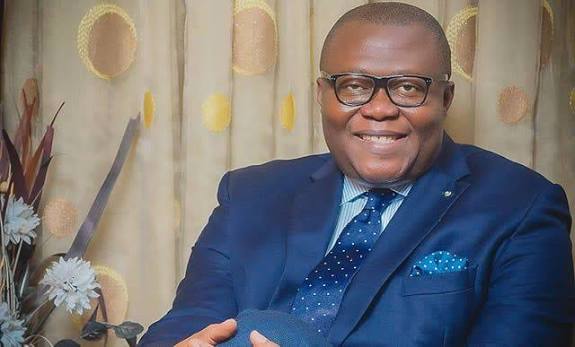
Writer Ehi Braimah has called on Rotary clubs across West Africa to prioritise lasting partnerships over short-term projects as the region prepares for the 2026 West Africa Project Fair.
The Fair, hosted by Rotary International Districts 9111 and 9112, is scheduled to hold from November 10 to 17 at the Balmoral Convention Centre, Sheraton Hotel, Ikeja, Lagos.
It will be flagged off by Rotary International President Olayinka Babalola and is expected to draw clubs, Rotarians, Rotaractors and international partners from nine districts across the region.
Braimah noted that the theme, “Partnerships for Lasting Impact,” reflects a shift from simply launching projects to ensuring that interventions continue to serve communities long after commissioning.
He argued that many development challenges in West Africa — including healthcare, education, water, sanitation, food security and environmental issues — transcend national borders and require collaborative solutions.
According to him, a common weakness in development work is the “project mentality,” where attention focuses on starting and completing initiatives rather than guaranteeing their long-term usefulness.
Braimah stressed that true partnerships go beyond sponsorship. They involve shared responsibility, technical expertise, institutional support, monitoring and local ownership.
He said the Project Fair offers a marketplace for clubs seeking funding or technical help to connect with partners who can provide resources, knowledge or institutional backing.
The column concluded that lasting impact is achieved when Rotary’s community presence is combined with the strengths of governments, businesses and development organisations, creating solutions that communities can sustain.
Columnist Ikeddy Isiguzo has raised fresh questions about the Lagos-Calabar Coastal Highway project and President Bola Tinubu’s second-term campaign strategy.
In his latest piece, Isiguzo criticised what he described as inconsistencies in explanations offered by Works Minister David Umahi regarding changes to the multi-billion-dollar highway.
He argued that the project, originally presented as a flagship infrastructure plan, has faced technical and financial challenges that were not adequately addressed at the outset.
Isiguzo recalled earlier concerns he raised in 2024 about the absence of detailed technical designs, environmental assessments and competitive bidding processes.
He also commented on the political dimensions of the project, noting recent statements by the minister linking adjustments to the route with presidential directives.
Turning to the 2027 elections, the columnist suggested that President Tinubu appears reluctant to campaign extensively across the country, preferring to rely on party structures and selected regional appearances.
Isiguzo listed proposed campaign locations and questioned the exclusion of certain states, interpreting the itinerary as a sign of limited political confidence.
He further criticised the ruling party’s internal dynamics, including competition among senior figures for future positions.
The column concluded with a brief reference to recent comments by the Edo State APC chairman on Peter Obi, describing them as extreme.
Isiguzo’s article continues his pattern of sharp commentary on governance and infrastructure under the current administration.
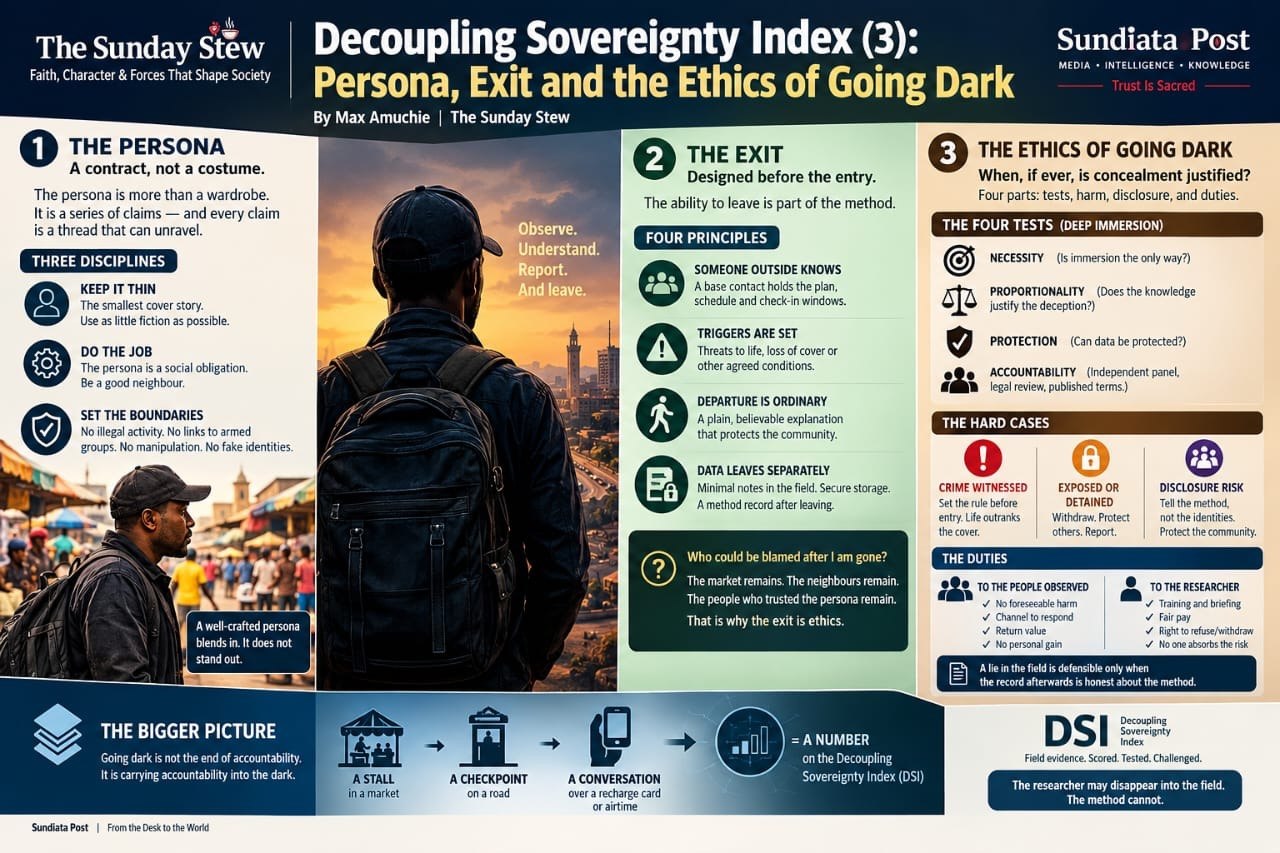
In the latest instalment of his Decoupling Sovereignty Index series, Max Amuchie examines the ethical obligations that arise when researchers adopt temporary identities to study decoupled zones.
Writing in The Sunday Stew, the Sundiata Post CEO and theorist argues that any methodology requiring a researcher to live under a borrowed role creates three unavoidable duties: the role must be disciplined, the researcher must be able to leave, and the deception must be ethically justified.
Amuchie treats the persona as a contract rather than a costume. He advises keeping the cover story thin, performing the assumed job properly, and setting clear boundaries before entering the field. These boundaries include never participating in illegal activity, never passing information to armed groups, never manipulating relationships solely to extract information, and never assuming the identity of a real person.
He stresses that the exit must be designed before entry. At the Sundiata Post Knowledge Lab, no researcher enters a zone until the exit plan is written down. This includes external check-ins, pre-agreed triggers for withdrawal, an ordinary departure story, and separating data from the person so that the community is not exposed after the researcher leaves.
On the ethics of “going dark,” Amuchie applies four tests: necessity, proportionality, protection and accountability. Immersion is justified only when remote or rapid methods cannot answer the research question.
The knowledge gained must outweigh the deception, and no observed person should face foreseeable harm. An independent panel must review and can veto any covert plan.
He addresses three hard cases: what to do if the researcher witnesses a crime, what happens if the persona is exposed, and how to disclose the method without endangering people. Life outranks the cover. Where imminent danger exists, the researcher must warn or withdraw even if it ends the assignment.
Amuchie insists that the duty runs both ways. The people observed must not pay a price for the findings, and the researcher must be trained, fairly paid and free to refuse or withdraw without penalty.
The column concludes that a lie in the field is defensible only when the later account is fully honest about the method. The people may be protected; the method may not.
Part 4 of the series will examine how field evidence is translated into scores on the Decoupling Sovereignty Index.
-
Politics3 years ago
13 Ondo Assembly Members Disown Endorsement of Aiyedatiwa
-
Politics3 years ago
APC Group, Ondo Govt, Quarrel Over Money for Endorsement
-

 Trending News5 years ago
Stop unsavoury, inciting statements – DSS warns
-

 Others5 years ago
Adron Homes Celebrates 10 Years Of Housing Excellence
-

 Humanity5 years ago
President Buhari Commiserates With Ambassador Maureen Tamuno Over The Loss Of Her Father
-

 Others7 years ago
EX- CUSTOMS BOSS, IBRAHIM MERA’S DWINDLING FAME
-

 Business2 years ago
Bigi Carbonated Soft Drinks Treats 40 Consumers to an Epic Easter Movie Hangout
-

 Business2 years ago
Wema Bank Shines at Global SME Finance Forum Conference Awards 2024 …Awarded: • SME Financier of the Year (Africa) • Platinum Award for Best Financier for Women Entrepreneurs (Africa)