
Opinion
Why Nigeria’s Ban on Sachet Alcohol is a Prescription for Public Health


BY AHMED TIJANI IBN MUSTAPHA

In a nation often gridlocked by debate, the Nigerian Senate’s firm stance against sachet alcohol represents a critical intervention for public health.
The 10th Senate’s recent resolution to enforce the ban on sachet alcohol production by December 31, 2025, has ignited a necessary firestorm. The conversation is, predictably, mixed. On one side, cries of “elitism” and economic hardship for the poor, on the other, a long-overdue sigh of relief from public health professionals and community leaders.
Let us be unequivocal, the Senate’s move is not an attack on the poor but a profound defence of them. It is a courageous, data-driven step to pull Nigeria back from the precipice of a full-blown public health crisis. This is not nanny-state politics; it is a critical triage for our national well-being.
The primary argument for sachet alcohol is its affordability. At just ₦150 to ₦200 per sachet, it is within reach for the most vulnerable. But this is a devil’s bargain. This very affordability is what makes it so perilous. We are not talking about an occasional beer; we are talking about potent, often unregulated spirits sold like candy, enabling consumption patterns that are destructive and continuous.
The data paints a grim picture. A 2022 study by the Centre for Research and Information on Substance Abuse (CRISA) revealed that over 70% of alcohol consumed in Nigeria is in the sachet and pet bottle category. The World Health Organization (WHO) estimates that alcohol is responsible for over 3 million deaths globally each year, and a significant portion of this burden falls on low and middle-income countries where consumption is rapidly increasing. In Nigeria, the unbridled access to cheap, high-strength alcohol is fueling a silent epidemic.
The dangers are not abstract, they are visible in our communities, our hospitals, and our homes.
The sachet’s design is a marketer’s dream and a parent’s nightmare. Easily concealed, cheap, and potent, it is the perfect gateway for underage drinking. Recent studies show a alarming 55.8% drinking prevalence among Nigerian youths, up from 30% in 2015 and 34% in 2021 . This exponential growth correlates directly with the proliferation of sachet alcohol. The WHO’s 2018 report already showed Nigeria had one of Africa’s highest rates of heavy episodic drinking among 15-19 year olds at 22.5% . When schoolchildren can purchase a shot of liquor for the price of a sweet, we are normalizing alcoholism in a generation. Reports confirm that children as young as 10 years old can purchase these sachets for as little as ₦100, raising fears of irreversible brain damage and addiction.
The Nigerian Medical Association (NMA) has consistently linked the rise in cases of liver cirrhosis, pancreatitis, and alcohol-related mental disorders to the proliferation of cheap spirits. The WHO directly links harmful alcohol use to more than 200 health conditions, including infectious diseases like tuberculosis and HIV/AIDS, non-communicable conditions like liver cirrhosis, and various cancers . Each sachet sold at ₦50 ultimately contributes to a healthcare cost running into hundreds of thousands of Naira for treating end-stage liver disease, a cost borne by families and an already overstretched public health system.
The link between alcohol abuse and social ills is indisputable. From domestic violence and road traffic accidents to absenteeism and lost productivity at work, the ripple effect is staggering. Senator Asuquo Ekpenyong, in his pivotal motion, rightly warned that these beverages fuel “youth addiction, road accidents, school dropouts, domestic violence and other social vices” . The National Drug Law Enforcement Agency (NDLEA) has explicitly noted that alcohol consumption by drivers at motor parks is directly contributing to road crashes, with alcohol-impaired driving responsible for nearly 50% of road fatalities globally . We are sacrificing long-term national productivity for short-term, predatory profit.
The Manufacturers Association of Nigeria (MAN) and the Distillers and Blenders Association of Nigeria (DIBAN) estimate that 500,000 jobs will be affected, with some projections rising to 5.5 million when considering the broader value chain . This is a serious concern in a challenging economy.
However, this argument ignores critical facts. First, this ban follows a five-year Memorandum of Understanding (MoU) signed in 2018 between the industry, the Federal Ministry of Health, and NAFDAC, agreeing to a phased ban . Manufacturers have had years to adapt their operations and transition to safer, more sustainable packaging. Second, the economic cost of not implementing the ban is far greater. The cumulative burden on our healthcare system, the loss of productivity from alcohol related illnesses and deaths, and the social costs of violence and accidents create a massive drain on the national economy. What is the price of a generation’s potential?
In the face of powerful lobbying from the distillers’ association and the easy populism of opposing the ban, the Nigerian Senate has chosen to stand on business. This is what leadership looks like. True governance is not always about giving the people what they want, but what they need for a safe and prosperous future.
We must give particular credit to the mover of this timely motion, Senator Asuquo Ekpenyong. His motion cut through the noise and placed the health and security of the Nigerian people, particularly our youth, at the forefront of the national agenda . It took foresight to recognize that the economic argument for sachet alcohol is a myopic one, dwarfed by the colossal social and healthcare costs we are already incurring. By insisting that “no further extensions would be tolerated,” Senator Ekpenyong has provided the legislative backbone for a policy that will be remembered as a turning point.
The Senate’s unanimous support for this motion, as echoed by Senator Anthony Ani who described the products as a “slow poison spreading among the youth,” and Senate President Godswill Akpabio who called it “a moral and patriotic stand,” demonstrates a rare and commendable unity of purpose . They have drawn a line in the sand, putting regulatory integrity and public health above private profit.
The mixed public conversation is understandable. Change is always met with resistance. But we must not confuse the loudness of a voice with the righteousness of its cause. The Senate, in this decision, has listened to the quieter, more sober voices of doctors, community leaders, and data.
This ban is not an end, but a beginning. It is the start of a more conscious approach to public health policy in Nigeria. It is a declaration that the well-being of our citizens is not for sale, not even for ₦50. The Senate has taken a definitive stand. It is now incumbent upon the executive arm, particularly NAFDAC and the Federal Ministry of Health, to enforce this ban without compromise and to expedite the release of the long-awaited National Alcohol Policy.
For this courageous, life-saving stand, the 10th Senate deserves our full and unequivocal support. They have chosen to protect Nigeria’s future, and history will judge this decision kindly.
-Ahmed Tijani Ibn Mustapha is a Senior Legislative Aide to the Senate President



By Ehi Braimah
Amid the diplomatic tensions between Nigeria and South Africa, another Nigerian named Ibeh Chika Simon, 42, died during a South Africa Police Service (SAPS) operation in Bellville, Cape Town, in Western Cape Province on July 23.
Also read: Nigeria Demands Action as Xenophobic Attacks Hit Businesses, Churches in South Africa
Witnesses and community groups alleged he was tortured, beaten and suffocated with a plastic bag during the raid. Another Nigerian, Patrick Chuks Egwabor, was reportedly shot and injured during the same operation.
Nigerian Consul-General in Johannesburg, Ninikanwa Okey-Uche, strongly condemned the death, and demanded a transparent, independent probe into recurring extrajudicial deaths involving security personnel.
Nigerians and other African migrants are being killed and forced to leave South Africa arising from the resurgence of xenophobic violence which, clearly, is one of the greatest moral contradictions confronting post-apartheid Africa.
Three decades after the dismantling of institutional racism, the country that inspired the world with Nelson Mandela’s message of reconciliation is witnessing repeated attacks against fellow Africans whose only “crime” is seeking opportunities to work, trade and build better lives.
Sentiment analysis indicates that the hostility directed at African migrants in South Africa is driven by a complex mix of extreme socio-economic frustrations, political scapegoating, inequalities, historical isolation, hunger, laziness, unemployment, and viral anti-immigrant activism.
The local elections are due in November, and as South Africa prepares for the vote, political analysts and rival parties have heavily criticised Jacob Zumah’s MK Party of fueling anti-immigrant sentiments.
MK Party has been accused of weaponising public frustration over extreme unemployment, poverty and state failures to gain electoral advantage.
Recent campaigns by the March and March Movement and Operation Dudula, which demanded that foreign African nationals leave South Africa ahead of the June 30 deadline, represents not merely an attack on migrants but a direct assault on the ideals upon which modern Africa was built.
While inflammatory rhetoric often targets Nigerians, Zimbabweans, Malawians, Mozambicans, Zambians, Ethiopians, Ghanaians, Somalis and other African nationals, it is striking that white immigrants and foreign investors rarely become the focus of such organised hostility.
This selective outrage exposes the uncomfortable reality that the problem is not immigration alone; it is Afrophobia directed against fellow Africans.
South Africans who embrace xenophobic violence have become poor students of history. They appear to have forgotten the enormous sacrifices made by African countries during the long struggle against apartheid. Nigeria, in particular, stood firmly with South Africa when much of the world hesitated.
Successive Nigerian governments contributed financially to the liberation struggle, imposed sanctions against the apartheid regime, offered scholarships to South African students in exile and mobilised international opinion against racial oppression.
Millions of ordinary Nigerians voluntarily contributed through the Southern African Relief Fund, believing that the freedom of South Africa was the responsibility of all Africans.
Nigeria was not alone. Zambia provided sanctuary for liberation fighters. Tanzania hosted the headquarters of liberation movements.
Mozambique, Angola, Zimbabwe, Botswana and many other African nations paid heavy economic and security costs because they stood on the side of justice.
Across the continent, African governments accepted refugees, financed resistance movements and defended South Africa’s right to freedom in international forums.
The vision that inspired these sacrifices was much bigger than the liberation of one country. Ghana’s first President, Kwame Nkrumah, dreamed of a politically and economically united Africa capable of determining its own destiny.
Nelson Mandela similarly believed that South Africa’s freedom would remain incomplete unless the entire continent prospered in peace and solidarity.
The African Union, which succeeded the Organisation of African Unity, inherited this vision of continental integration, cooperation and free movement.
Today, that noble dream is under serious threat.
When African migrants are hunted in townships, their businesses looted, their homes burnt and their families terrorised, Africa loses a part of its collective soul.
The victims are not statistics. They are fathers, mothers, students, traders, artisans, professionals and entrepreneurs who have invested years of hard work in building livelihoods.
Many possess valid immigration documents; work permits or permanent residence status. Yet, legality often provides little protection when mobs take the law into their own hands.
The humanitarian consequences are heartbreaking. Families are uprooted overnight; children abandon their education, and businesses painstakingly built over many years are destroyed within hours. Savings accumulated over decades disappear in acts of arson and looting.
Many migrants return home traumatised, carrying nothing except painful memories of violence and rejection. Nigeria, Zimbabwe, Malawi, Zambia, Mozambique and several other African countries have repeatedly received distressed returnees who must begin life all over again.
The Nigerian government has repeatedly expressed concern over the deaths of Nigerian nationals in violent attacks over the years, underscoring the urgent need for stronger protection and accountability.
Regardless of the precise number, every life lost represents a profound tragedy and a reminder that no African should die simply because he or she chose to live or work in another African country.
The economic argument often advanced by xenophobic groups is equally flawed. Foreign African entrepreneurs frequently establish businesses in communities underserved by formal retail chains, create employment for local residents, pay taxes, rent commercial property and contribute to economic activity.
Rather than causing unemployment, many become job creators. South Africa’s unemployment crisis stems from deep structural economic challenges that cannot be solved by intimidating vulnerable migrants.
Equally troubling is the rise of hate speech that portrays African migrants as criminals responsible for every social ill. Such dangerous generalisations inflame public anger and legitimise violence.
Criminal behaviour should always be addressed through law enforcement against individuals, not through collective punishment based on nationality. The rule of law cannot coexist with mob justice.
As African leaders prepare for the African Union Extraordinary Summit on Conflict Prevention and Resolution in Angola from August 29 – 30, xenophobia and Afrophobia deserve urgent attention.
The African Union cannot remain silent while one of its founding principles is systematically undermined.
The AU’s Agenda 2063 envisions “An Integrated, Prosperous and Peaceful Africa.” That aspiration cannot coexist with violent campaigns demanding that fellow Africans leave another African country.
Moreover, the African Charter on Human and Peoples’ Rights guarantees dignity, equality before the law and protection from discrimination.
The Protocol relating to the African Economic Community and the African Continental Free Trade Area equally seek to deepen regional integration by facilitating the movement of people, goods, services and investment.
Continental economic integration cannot flourish where fear and violence replace trust and cooperation.
South Africa’s government bears the primary responsibility for protecting everyone living within its borders, irrespective of nationality.
Peaceful protests may be protected under democratic principles, but intimidation, incitement, destruction of property and mob violence are criminal acts that demand firm prosecution. Failure to hold perpetrators accountable only emboldens future attacks.
Although President Cyril Ramaphosa of South Africa sent a delegation led by Ronald Lamola, the country’s minister of International Relations and Cooperation to Abuja for diplomatic engagements over the attack on Nigerians, Ramaphosa should be told in clear terms that his government is not going far enough to solve the problem.
There’s no way South Africa can stand alone as an island, separated from the rest of Africa and an interconnected world.
Nigeria’s President, Bola Ahmed Tinubu, should be commended for showing restraint over the provocations from South Africa that undermine decades of cordial relations between both countries.
How can a South African Minister be saying on national television that Nigeria should show them where the drug dens are?
Governments across Africa must strengthen cooperation on migration management, documentation, intelligence sharing and employment policies. Migration is a global phenomenon that requires coordinated solutions, not xenophobia.
Political leaders, religious institutions, civil society organisations, schools and the media must actively promote tolerance and remind younger generations of the shared history that united Africa against colonialism and apartheid.
Africa’s destiny lies not in division but in unity. Kwame Nkrumah’s dream of continental integration and Nelson Mandela’s vision of reconciliation remain as relevant today as ever.
To betray fellow Africans through xenophobia is to betray the very struggle that delivered South Africa from apartheid.
The answer to unemployment is economic reform, not hatred, and effective policing, not ethnic profiling, will address criminality.
Cyril Ramaphosa must understand that accountable governance, not scapegoating and criminalising vulnerable migrants, will reduce frustration among jobless South Africans.
Africa cannot build a single market while destroying our common humanity.
The African Union must speak with one voice against xenophobia and Afrophobia, demand accountability for perpetrators of violence and reaffirm that every African deserves dignity, security and equal protection under the law wherever they lawfully reside on the continent.
History will judge Africa not only by how it defeated apartheid, but also by whether it refused to replace one form of intolerance with another.
Also read: FG Intensifies Nigeria Evacuation Over Rising Xenophobia Fears in South Africa
Africa must unite, not divide. That is the only path to fulfilling the dreams of Kwame Nkrumah, Nelson Mandela and the founding fathers of African unity.

By Ehi Braimah
Africa has emerged as one of the most strategic frontiers for global investment, trade, innovation, and economic transformation.
Also read: Customs Reform Will Unlock AfCFTA’s Full Potential, Experts Say
With a population projected to exceed 2.5 billion by 2050, abundant natural resources, a rapidly expanding middle class, and the world’s youngest workforce, the continent is increasingly attracting the attention of governments, multinational corporations, investors, development institutions, and entrepreneurs.
Against this backdrop, global business summits hosted in Africa and across the world on Africa, have become vital platforms for dialogue, partnership-building, and economic cooperation.
From investment forums and trade expos to leadership conferences and innovation summits, these gatherings bring together policymakers, business executives, financiers, academics, and development experts to discuss opportunities and challenges shaping Africa’s future.
Beyond networking events, they have become powerful instruments for driving economic growth, fostering regional integration, and positioning Africa as a key player in the global economy.
The summits on Africa and where they hold
The France-Africa Summit, otherwise known as Africa Future Forward Summit, held in Nairobi, Kenya from May 11 – 12 for the first time in an Anglophone country.
It was followed by Biashara Afrika in Lome, Togo, which held from May 18 – 22, while the London-Africa Business Summit convened by Sadiq Khan, the Mayor of London, held on June 4.
The London Summit attracted diaspora professionals, international investors, and policymakers to discuss the harmonisation of capital markets, tech investments and economic growth on Africa.
On July 30, the Global Africa Summit will hold at the Toronto Metropolitan University, Toronto, Canada. The summit will focus on translating Canada’s Africa Strategy into tangible trade, fintech, infrastructure, and green energy by connecting institutional investors with emerging African markets.
Other major and annual recurring events include the US-Africa Business Summit holding in Mauritius from July 26 – 29, co-hosted by the Corporate Council on Africa and the Government of Mauritius; the Opportunities in Africa Summit in New York City where investors and entrepreneurs explore Foreign Direct Investment (FDI) opportunities in high-growth markets like Rwanda, Senegal and Cote d’Ivoire.
There’s also the US-Africa Leaders’ Summit in Washington DC, USA; the Africa CEO Forum, the Climate Change Global Business Summit on Africa which holds in Nairobi, Kenya; the Financial Times (FT) Africa Summit that will hold from October 21 – 22, at The Landmark, London; the Transform Africa Summit, the continent’s premier annual forum on technology, innovation and digital transformation organised by Smart Africa Alliance, and others.
Growing relevance of the summits
Global business summits serve as meeting points where ideas, capital, and opportunities converge. Their relevance has increased significantly as African economies seek to diversify beyond traditional sectors such as oil, gas, and mining into manufacturing, technology, agriculture, renewable energy, healthcare, and digital services.
These summits provide a unique platform for governments to showcase investment opportunities and policy reforms aimed at attracting FDI.
Investors, in turn, gain valuable insights into emerging markets, regulatory environments, and sector-specific opportunities.
For local businesses, the events offer exposure to international markets, potential partners, and financing sources.
The role of AfCFTA
The African Continental Free Trade Area (AfCFTA) should be the economic anchor of every Africa-focused global business summit.
Whether in Abuja, Lagos, Nairobi, Kigali, Mauritius, Paris, London, New York, Washington DC, Dubai, Moscow, or Beijing, AfCFTA must be presented not merely as a trade agreement but as Africa’s blueprint for industrialisation, regional value chains and a single market of over 1.4 billion people.
Rather than promoting 54 fragmented economies, African leaders should speak with one voice, using AfCFTA to attract investment in manufacturing, infrastructure, digital technology, agriculture and clean energy.
Global summits on Africa should therefore move beyond aid and commodity exports to partnerships that expand intra-African trade, technology transfer, skills development and value addition.
A united AfCFTA agenda will strengthen Africa’s bargaining power, reduce trade barriers, create jobs and position the continent as a competitive global investment destination.
Africa’s economic transformation depends on making AfCFTA the centrepiece of every international business engagement.
Benefits
One of the most significant benefits of global business summits is their ability to attract investment. Many investment deals, public-private partnerships, and development projects originate from conversations initiated during these events.
By bringing together key decision-makers in one location, summits reduce barriers to engagement and facilitate quicker decision-making.
Another major benefit is knowledge exchange. Participants gain access to expert insights on market trends, emerging technologies, sustainable development practices, climate finance, and global economic shifts.
Such knowledge helps businesses and governments make informed decisions that enhance competitiveness and resilience.
Business summits also stimulate tourism and local economic activity. Hotels, transportation services, restaurants, event management firms, and other service providers benefit from the influx of delegates.
Host cities often gain international visibility, improving their reputation as business and investment destinations.
Furthermore, these events contribute to capacity building. Young entrepreneurs, startups, and small and medium-sized enterprises (SMEs) gain opportunities to learn from industry leaders, access mentorship, and connect with investors. This helps nurture the next generation of African business leaders and innovators.
On a broader scale, global business summits support economic diplomacy. Governments use these platforms to strengthen bilateral and multilateral relationships, negotiate trade agreements, and promote regional cooperation. Such engagements can lead to long-term economic partnerships that benefit multiple countries.
Africa’s strategic importance in the global economy
The increasing number of global business summits on Africa reflects the continent’s growing strategic importance.
Africa possesses approximately 30 percent of the world’s mineral reserves, including critical minerals such as cobalt, lithium, manganese, and rare earth elements that are essential for electric vehicles, renewable energy technologies, and advanced manufacturing.
In addition, Africa’s agricultural potential remains largely untapped. The continent holds vast areas of arable land capable of contributing significantly to global food security.
Its expanding urban population and rising consumer demand also make it one of the most promising growth markets in the world.
The continent’s digital revolution further enhances its attractiveness. Mobile technology, fintech innovation, e-commerce, and digital payment systems have transformed business operations across many African countries such as Nigeria and Kenya.
Investors increasingly view Africa not only as a source of raw materials but also as a market for innovation and technological advancement.
The new scramble for Africa
The growing international interest in Africa has led many analysts to describe current geopolitical and economic competition as a “New Scramble for Africa.” Unlike the colonial-era scramble of the late nineteenth century, today’s competition is driven primarily by economic, technological, and strategic interests rather than direct territorial control.
Major global powers, including the United States, China, the European Union, India, Turkey, Russia, and Gulf states, are actively expanding their engagement across Africa.
They compete for access to natural resources, infrastructure projects, trade opportunities, energy partnerships, digital markets, and geopolitical influence.
China has become one of Africa’s largest trading partners and infrastructure financiers, investing heavily in roads, railways, ports, and industrial parks.
Western nations have responded by increasing investment initiatives focused on sustainable development, clean energy, digital infrastructure, and private sector growth.
Meanwhile, emerging powers are seeking to deepen commercial and diplomatic ties through trade agreements, investment missions, and development partnerships.
Global business summits often serve as arenas where these competing interests intersect. International corporations and governments use such forums to announce investment commitments, launch strategic partnerships, and strengthen economic relationships with African nations.
While increased global attention creates opportunities for growth and development, it also presents challenges. African countries must ensure that investments contribute to sustainable development, local job creation, technology transfer, and industrialization.
Effective governance, transparency, and strategic negotiation are essential to ensuring that Africa derives maximum benefit from foreign engagement.
Africa’s future
As Africa’s economic influence continues to grow, global business summits will play an increasingly important role in shaping the continent’s future.
These events provide platforms for investment mobilisation, innovation exchange, policy dialogue, and international cooperation.
They also help position African countries as active participants in global economic decision-making rather than passive recipients of external interests.
The challenge and opportunity for Africa lie in leveraging these platforms to advance its own development priorities.
By fostering strategic partnerships, promoting intra-African trade, supporting entrepreneurship, and ensuring inclusive growth, business summits can become powerful catalysts for transformation.
In the context of the new scramble for Africa, the continent is no longer merely a destination for external interests.
Increasingly, it is becoming a dynamic actor with the capacity to shape global markets, influence international investment flows, and define its own development trajectory.
Also read: Customs Reform Will Unlock AfCFTA’s Full Potential, Experts Say
Global business summits on Africa provide one of the most visible and effective mechanisms through which this transformation can be realised.
By Max Amuchie | The Sunday Stew
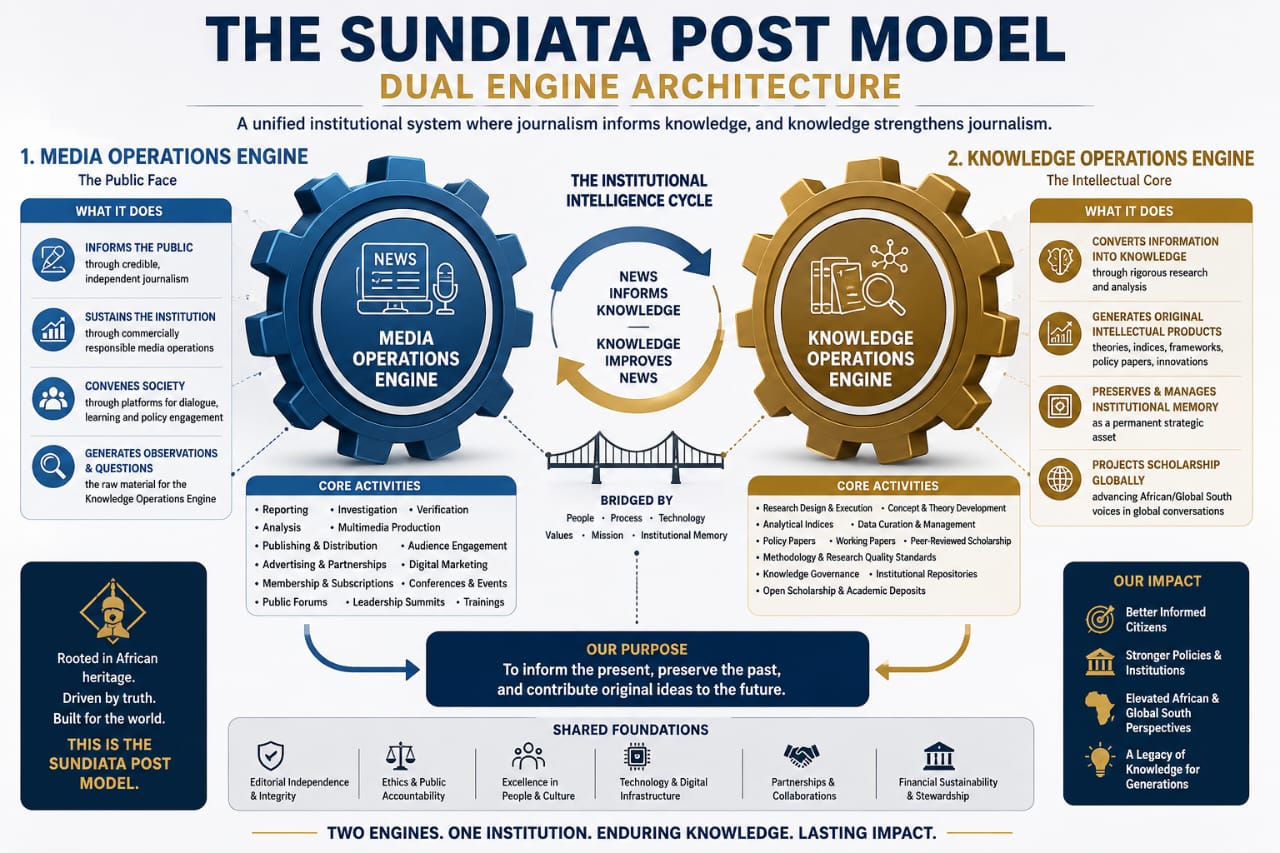
This fourth instalment of the Sundiata Post Model asks the inevitable question: What must a knowledge-producing newsroom do to survive, adapt and remain relevant across generations?
Also read: Sundiata Post Boss Max Amuchie Earns ScienceOpen Academic Appointment
That question is the gateway to what we call the Realm of the Long Term.
Every institution eventually enters the Realm of the Long Term. It is the stage at which immediate success gives way to enduring relevance, and where the central question is no longer whether an organisation can perform today, but whether it can continue creating public value across generations. Entering this realm requires more than ambition.
It demands governance, institutional memory, financial resilience, leadership succession, continuous learning and an unwavering commitment to trust. This is the realm in which institutions either become enduring or gradually disappear.
The Realm of the Long Term is the point at which management ceases to focus primarily on performance and begins to focus on long-term stewardship.
Decisions are evaluated not only by their immediate outcomes but by their contribution to the institution’s capacity to create enduring public value across generations.
Within the Sundiata Post Model the Realm of the Long Term rests on seven interdependent pillars: Financial Sustainability, Human Capital and Leadership, Knowledge Stewardship, Governance, Innovation and Adaptation, Trust and Reputation, and Mission Continuity.
Together, these pillars determine whether an institution merely survives the present or continues creating public value across generations.
Financial Sustainability
Financial Sustainability is the institution’s capacity to generate, diversify, steward and invest financial resources in ways that preserve its independence, strengthen its capabilities and enable it to pursue its mission across generations.
Financial Sustainability is the institution’s capacity to generate diverse, mission-aligned sources of income that preserve its independence while strengthening both its Media Operations Engine and its Knowledge Operations Engine over the long term.
No institution, however compelling its vision or noble its mission, can endure without the economic capacity to sustain its work. Institutions do not survive on ideas alone.
They survive because they deliberately create the financial resources that allow those ideas to mature into enduring public value.
Within the Sundiata Post Model, Financial Sustainability is understood differently from its conventional treatment in management literature. It is not simply about generating revenue, balancing budgets or maintaining profitability.
Rather, it is the strategic financing of a knowledge-producing institution. Its purpose is to preserve institutional independence while providing the resources required to sustain both the Media Operations Engine and the Knowledge Operations Engine over the long term.
The Media Operations Engine generates value through journalism and public engagement. Its financial ecosystem includes advertising, brand partnerships, digital marketing, content syndication, commercial publishing, multimedia production, conferences, annual lectures, policy dialogues, executive forums and other public-facing institutional activities.
These are not merely commercial ventures; they are mission-aligned enterprises that strengthen the institution’s capacity to produce independent journalism.
The Knowledge Operations Engine expands the institution’s financial horizon beyond the traditional economics of media.
As the institution generates original knowledge, it creates opportunities for research grants, commissioned studies, partnerships with universities, think tanks and research institutions, collaborative projects with international organisations, consultancy, executive education, policy research, book publishing, biographies, proprietary datasets and the licensing of analytical frameworks, indices and methodologies.
Knowledge itself becomes an institutional asset capable of creating both public value and sustainable income.
This represents a fundamental shift in how media organisations think about finance.
The Sundiata Post Model recognises that journalism and knowledge production are complementary economic activities.
The first generates public attention, civic engagement and commercial opportunities; the second generates intellectual capital, scholarly influence and knowledge-based revenue.
Together, they produce a diversified and resilient institutional economy capable of supporting long-term growth without compromising editorial independence or research integrity.
Financial Sustainability therefore extends beyond accounting. It encompasses the institution’s capacity to build strategic partnerships, secure collaborative projects, attract research funding, develop intellectual property and transform original ideas into enduring institutional assets.
In the Realm of the Long Term, Financial Sustainability is ultimately the stewardship of institutional resources in service of institutional purpose.
It is the first pillar because every other pillar depends upon it. Without sustainable financing, governance becomes fragile, knowledge production becomes intermittent, innovation slows, leadership development suffers and institutional memory gradually erodes.
2. Human Capital and Leadership
If Financial Sustainability provides the economic foundation of an enduring institution, Human Capital and Leadership provide its human foundation.
Buildings, technology, financial resources and even brilliant institutional designs do not create enduring organisations by themselves. Institutions ultimately rise or decline because of the quality of the people who lead them and the culture they cultivate.
Within the Sundiata Post Model, Human Capital extends beyond recruitment.
It encompasses the deliberate attraction, development, retention and continuous renewal of talented professionals who possess not only technical competence but also a commitment to the institution’s mission, values and standards.
An institution enters the Realm of the Long Term only when it begins to think beyond filling positions to building generations of capable people.
Leadership occupies a special place within this pillar. The true measure of leadership is not merely what is accomplished during a leader’s tenure, but what remains after that tenure has ended. Institutions become enduring when leadership is viewed as stewardship rather than ownership.
Every generation of leaders inherits an institution from those who came before and bears the responsibility of strengthening it for those who will come after.
This requires intentional investment in professional development, mentorship, succession planning and organisational culture.
Expertise must be cultivated. Institutional values must be transmitted. Leadership pipelines must be continuously renewed.
The departure of talented individuals should never threaten the continuity of the institution because knowledge, experience and responsibility lhave been systematically transferred to the next generation.
For a knowledge-producing institution, this responsibility becomes even greater. Journalists must continuously improve their craft.
Researchers must deepen their methodological competence. Editors must strengthen both editorial judgment and institutional leadership.
The objective is not merely to employ professionals but to cultivate an intellectual community capable of sustaining journalism, research and public service over the long term.
3. Knowledge Stewardship
Knowledge Stewardship is the deliberate creation, preservation, governance and transmission of institutional knowledge so that learning accumulates rather than disappears.
Every institution produces knowledge through its daily operations. Yet much of that knowledge is often lost through staff turnover, poor documentation or organisational neglect. The Sundiata Post Model rejects this waste.
It regards datasets, editorial experience, research outputs, methodologies, institutional records and accumulated expertise as strategic assets that must be governed, preserved and continuously enriched. Knowledge stewardship transforms experience into institutional capital.
4. Governance
Governance is the system of structures, principles and accountability through which an institution safeguards its mission, exercises authority responsibly and makes sound strategic decisions.
Strong institutions are not sustained by personalities alone but by systems that outlive individuals.
Effective governance establishes clear responsibilities, ethical standards, transparency, accountability and strategic oversight.
It protects institutional integrity during periods of growth, crisis and leadership transition. Within the Realm of the Long Term, governance provides stability without preventing innovation.
5. Innovation and Adaptation
Innovation and Adaptation are the institution’s capacity to respond intelligently to changing technological, economic and social environments while remaining faithful to its core mission.
Long-term institutions do not survive by resisting change.
They survive by adapting continuously without abandoning the principles that define them. Innovation therefore extends beyond technology.
It includes new products, new organisational practices, new revenue models, new research methods and new ways of engaging society. Adaptation ensures relevance; mission provides continuity.
6. Trust and Reputation
Trust and Reputation constitute an institution’s accumulated credibility, earned through consistent competence, integrity and public service over time.
Trust is not created by slogans or marketing campaigns. It is built gradually through countless decisions that demonstrate reliability, fairness and professionalism.
Reputation becomes one of an institution’s most valuable strategic assets because it influences public confidence, partnerships, talent recruitment and long-term legitimacy.
In the Sundiata Post Model, trust is not simply an ethical aspiration; it is an institutional resource that must be deliberately protected.
7. Mission Continuity
Mission Continuity is the institution’s ability to preserve its fundamental purpose while continually renewing its strategies, structures and methods.
Institutions that endure distinguish between mission and method. Their purpose remains constant even as the means of fulfilling that purpose evolve.
Mission continuity prevents organisations from losing their identity in response to short-term pressures while enabling them to adapt confidently to changing circumstances.
It provides the enduring direction that unites successive generations of leaders, professionals and stakeholders.
The seven pillars are mutually reinforcing. They are not independent compartments that can be strengthened or weakened in isolation.
The erosion of one inevitably affects the others, because institutions endure as integrated systems rather than as collections of separate functions.
Without Financial Sustainability, you cannot recruit and retain the best people (Human Capital and Leadership).
Without capable people, Knowledge Stewardship deteriorates.
Without Knowledge Stewardship, Innovation and Adaptation becomes weak because there is little accumulated knowledge to build upon.
Weak Governance eventually damages Trust and Reputation.
Once trust declines, revenue suffers, weakening Financial Sustainability again.
Eventually, Mission Continuity is threatened.
The Global South
While the region has produced many outstanding newspapers and broadcasters, relatively few have demonstrated the kind of uninterrupted institutional continuity that characterises some of the world’s oldest media organisations.
Political instability, economic volatility, succession challenges, fragile governance structures and rapidly changing media economics have made institutional longevity the exception rather than the rule.
The Realm of the Long Term is therefore not merely about preserving an existing institution; it is about addressing one of the enduring structural weaknesses of media development in Africa and much of the Global South.
The ambition is to build media organisations that do not merely survive their founders, but continue to generate public value across generations.
However, there are few media institutions that have proved capable of surviving across generations.
In Nigeria, the Nigerian Tribune, founded in 1949 by Obafemi Awolowo, has endured for more than seven decades, surviving colonial rule, independence, military governments, democratic transitions and the digital revolution.
In South Asia, The Hindu in India, established in 1878, and Dawn in Pakistan, founded in 1941, have likewise sustained their institutional identities through profound political, economic and technological change.
In the developed world, organisations such as Reuters (founded in 1851), The Economist (established in 1843), The New York Times (founded in 1851) have demonstrated similar resilience over even longer periods.
The longevity of these institutions suggests that enduring media organisations share certain characteristics.
They invest in governance, preserve institutional memory, renew leadership, adapt to technological change, cultivate public trust and develop sustainable business models.
Their endurance is rarely accidental; it is the product of deliberate institutional choices sustained over decades.
The Sundiata Post Model seeks to identify, organise and systematise institutional principles that appear repeatedly among such media organisations. In that sense, it is both descriptive and prescriptive.
It draws lessons from enduring institutions while proposing a coherent framework for building the knowledge-producing newsroom of the twenty-first century.
Finally, history shows that ideas sometimes outgrow the domains in which they were first conceived. Sun Tzu’s The Art of War was written as a treatise on military strategy, yet its principles have since informed thinking on business, leadership and organisational management.
Likewise, while the Sundiata Post Model is proposed as a framework for twenty-first-century journalism, its underlying principles of knowledge production, institutional memory, governance and long-term stewardship may ultimately prove relevant to other knowledge-intensive organisations.
Also read: Sundiata Post Marks Milestone as Amuchie’s Theory Goes Global
Whether that broader applicability emerges is not for me, as its author, to determine, but for others—scholars, intellectuals, media executives, publishers, and management experts—to test, adapt, critique and refine through practice.
Trust is sacred. Stay seasoned
-
Politics2 years ago
13 Ondo Assembly Members Disown Endorsement of Aiyedatiwa
-
Politics2 years ago
APC Group, Ondo Govt, Quarrel Over Money for Endorsement
-

 Trending News5 years ago
Stop unsavoury, inciting statements – DSS warns
-

 Others4 years ago
Adron Homes Celebrates 10 Years Of Housing Excellence
-

 Humanity4 years ago
President Buhari Commiserates With Ambassador Maureen Tamuno Over The Loss Of Her Father
-

 Others7 years ago
EX- CUSTOMS BOSS, IBRAHIM MERA’S DWINDLING FAME
-

 Business2 years ago
Bigi Carbonated Soft Drinks Treats 40 Consumers to an Epic Easter Movie Hangout
-

 Business2 years ago
Wema Bank Shines at Global SME Finance Forum Conference Awards 2024 …Awarded: • SME Financier of the Year (Africa) • Platinum Award for Best Financier for Women Entrepreneurs (Africa)